
How it works
From open reflection to a personalized direction.
The assessment is adaptive, not static — no two people answer the same set of questions. Here's what actually happens between the question you answer and the report you read, including the human review step most AI tools skip.
Reflect
Answer one open-ended question at a time — never a wall of questions at once. Most responses run 100+ words; the depth is what the analysis is built on.
Adapt
After a fixed set of anchor questions covering every core dimension, the engine selects each next question based on what your answers have already revealed, probing tensions and following genuine signal rather than a fixed script.
Extract
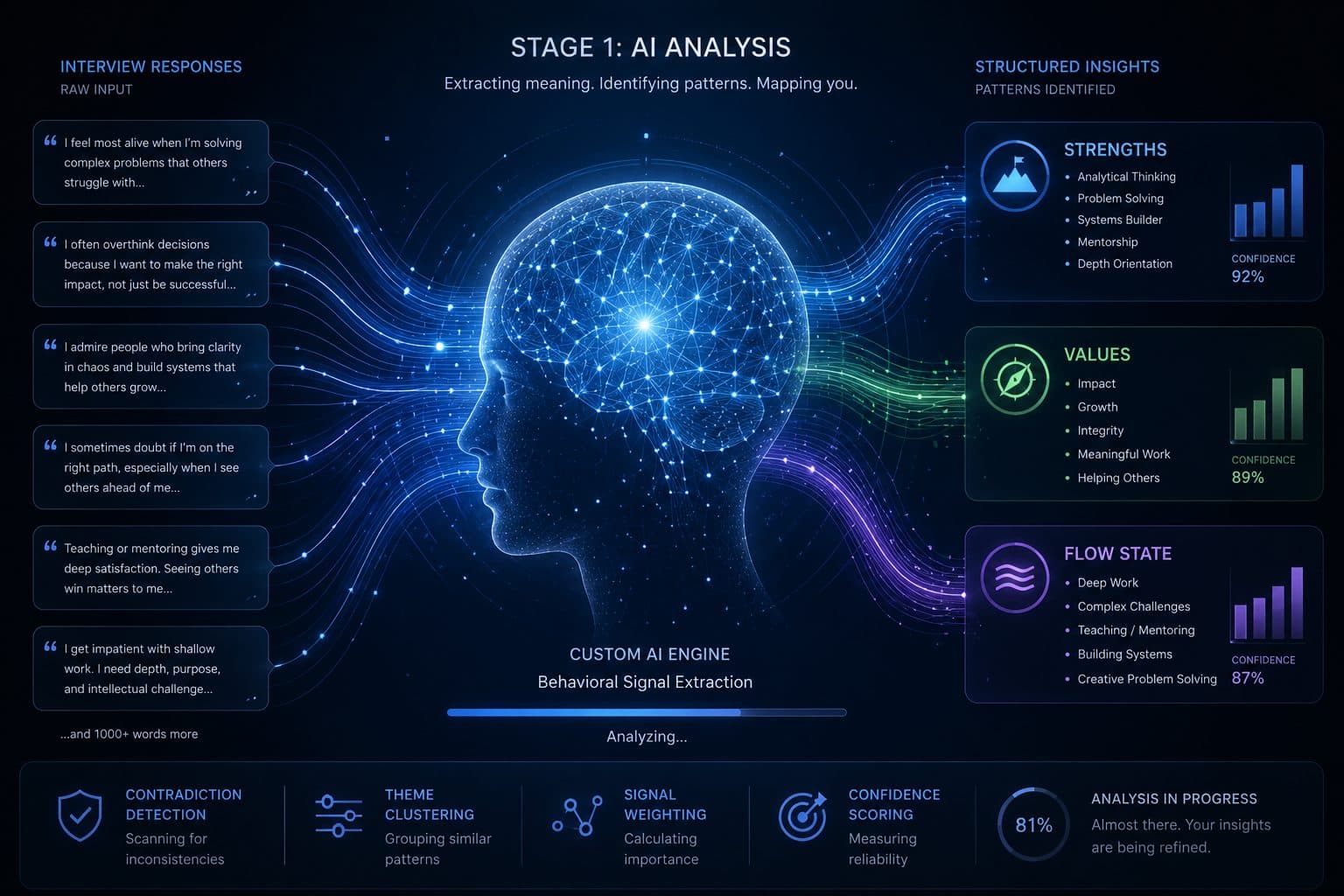
Each response is analyzed for recurring themes, values, motivations, and emotional signals — evidence, not guesses.
Synthesize
Signals are aggregated across your entire assessment to find dominant patterns, and checked for internal tensions — like a stated desire for freedom sitting alongside consistently security-seeking choices.
Write
A purpose profile, a set of ranked purpose hypotheses, and a full report draft are generated — every claim distinguishing observed pattern from interpretation from recommendation. Your purpose profile is on your dashboard instantly.
Review
A licensed member of our clinical team — psychologists, therapists, counselors, or behavioral researchers — reads the full report draft against your actual responses before it's released. Typically 4-5 business days.
Deliver
Your results dashboard, full report, and certificate of completion are ready — and stay accessible permanently.
A note on how the report is written
Every section of your report distinguishes an observed pattern (grounded in specific responses) from an interpretation (calibrated — “your responses suggest…”, never stated as settled fact) from a recommendation (a concrete next step). Where the evidence doesn't converge on one clear direction, the report presents multiple purpose hypotheses rather than forcing a single answer.